When businesses sign up for a commercial cleaning contract, they often focus on price, frequency, and start date. What many overlook — until something goes wrong — is the cleaning specification. Yet it is the cleaning specification that determines whether your contractor is genuinely accountable for what they deliver, or whether disputes about standards become a matter of opinion rather than fact.
This guide explains what a cleaning specification is, what it should include, why it matters for your business, and how to ensure yours is fit for purpose.
What Is a Cleaning Specification?
A cleaning specification — sometimes referred to as a cleaning scope of works or cleaning schedule document — is a detailed written document that sets out exactly what cleaning tasks will be carried out in your premises, how frequently each task will be completed, and to what standard.
It is, in effect, the technical backbone of your cleaning contract. Where the contract sets out the commercial and legal terms of the arrangement, the cleaning specification sets out the operational detail — what gets cleaned, when, how, and by whom.
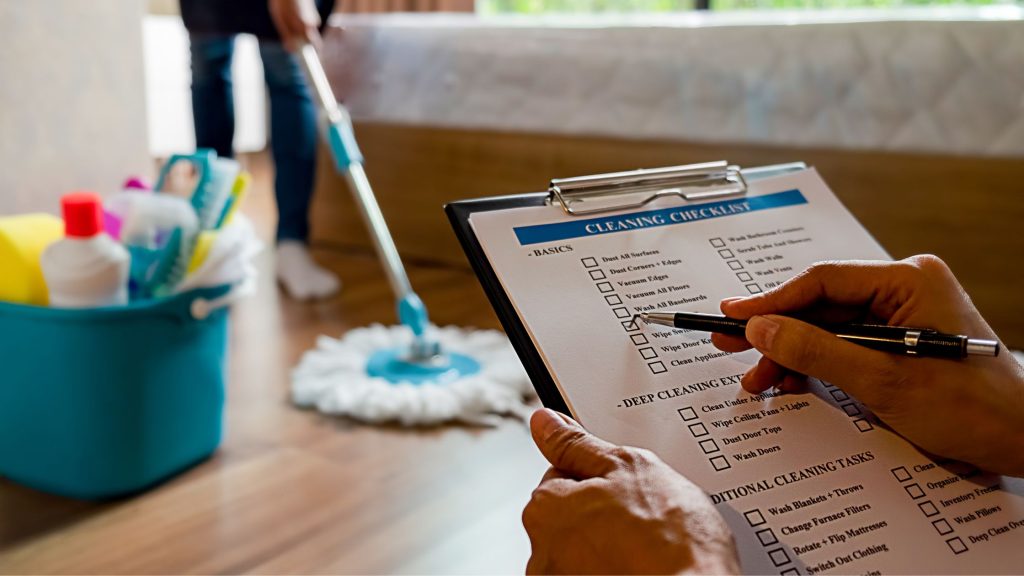
A well-written cleaning specification is specific enough to be used as a checklist by the cleaning operative on site, and detailed enough to form the basis of a quality audit if the standard of cleaning is ever called into question.
Why a Cleaning Specification Matters
Without a cleaning specification, your cleaning contract is built on assumptions. Both parties may have a different understanding of what “a clean office” means — and when expectations are not met, there is no objective document to refer back to.
A cleaning specification matters for several reasons. It creates clarity and accountability — both you and your contractor know exactly what is expected, and there is a written record to refer to if standards slip. It supports quality monitoring — a specification gives you a framework for carrying out inspections and raising concerns in a structured way. It protects you in disputes — if your contractor fails to deliver the agreed standard, the specification is your evidence. And it supports compliance — in regulated industries, a documented cleaning specification is often a requirement rather than a recommendation.
For guidance on workplace hygiene obligations and documentation requirements, the Health and Safety Executive provides clear guidance for businesses on maintaining safe and clean working environments: HSE — Workplace Health, Safety and Welfare
Key Components of a Cleaning Specification
A comprehensive cleaning specification should cover the following areas:
Area-by-Area Breakdown
The specification should list every area of your premises — offices, meeting rooms, reception, toilets, kitchens, corridors, staircases, car parks, and any specialist areas — and set out the cleaning tasks required in each. Generic references to “common areas” or “office space” are not sufficient. Each area should be listed individually.
Task List and Frequency
For each area, the specification should list every cleaning task and the frequency at which it will be carried out — daily, weekly, monthly, or periodically. This might include vacuuming carpets daily, wiping down surfaces three times per week, descaling taps monthly, and deep cleaning kitchen appliances quarterly.
Cleaning Methods and Products
A thorough specification will reference the cleaning methods and products to be used in each area — including whether disinfectants or specialist products are required, and whether colour-coded cleaning equipment will be used to prevent cross-contamination. In regulated environments such as healthcare or food production, this section is particularly important.
COSHH Considerations
Any specification that involves the use of chemical cleaning products should reference COSHH (Control of Substances Hazardous to Health) compliance — confirming that the products used are appropriate, that operatives are trained in their safe use, and that COSHH data sheets are available on site.
For guidance on COSHH obligations in the workplace, the Health and Safety Executive provides detailed resources for employers and contractors: HSE — COSHH Guidance for Businesses
Performance Standards
The specification should set out the standard to which each task should be completed — for example, “all hard floors to be mopped and free of visible soiling” or “all glass surfaces to be smear-free and streak-free.” Clear performance standards make quality auditing straightforward and remove ambiguity from the assessment process.
Review and Amendment Process
A good specification should include a process for reviewing and updating the document — for example, when the layout of the premises changes, when new areas are added, or when cleaning requirements evolve. It should be treated as a living document rather than a one-off exercise.
Who Should Write the Cleaning Specification?
In most cases, the cleaning specification is prepared by the cleaning contractor as part of the onboarding process — based on a site survey or assessment of your premises. However, it is important that you as the client review, agree, and sign off the specification before work begins.
Do not accept a generic specification that has not been tailored to your premises. A reputable cleaning company will carry out a site visit, understand the specific requirements of your environment, and produce a document that reflects the actual scope of work — not a templated document with your name added to the top.
If you are switching providers, ask for a copy of the existing specification from your current contractor and use it as the starting point for discussions with your new provider. This ensures continuity and reduces the risk of tasks being overlooked during the transition.
To find out more about how Hashtag Clean develops bespoke cleaning specifications for commercial clients, visit our Commercial Cleaning Service Page.
How a Cleaning Specification Supports Compliance
In regulated industries, a documented cleaning specification is not optional — it is a requirement. Healthcare providers regulated by the Care Quality Commission (CQC), food businesses inspected by the Food Standards Agency (FSA), and educational settings subject to Ofsted inspection are all expected to demonstrate that cleaning is carried out to a documented and auditable standard.
Even in less regulated environments, having a cleaning specification in place demonstrates a commitment to maintaining a safe and healthy workplace — which is relevant to employers’ obligations under the Health and Safety at Work Act 1974.
For further guidance on food hygiene and cleaning documentation requirements for food businesses, the Food Standards Agency provides detailed resources for businesses operating in catering and food production environments: Food Standards Agency — Food Hygiene Guidance
How Hashtag Clean Creates Bespoke Cleaning Specifications
At Hashtag Clean, every new commercial cleaning contract begins with a thorough site assessment. We assess the layout and use of each area, the footfall and occupancy levels, any specialist cleaning requirements, relevant compliance obligations, and the frequency and scheduling requirements of the client.
From this assessment, we produce a detailed cleaning specification that is specific to your premises — covering every area, every task, every frequency, and every performance standard. The specification is agreed with you before work begins and reviewed regularly to ensure it remains accurate and relevant as your business evolves.
To find out more about our approach to office and commercial cleaning, visit our Office Cleaning Service Page.
Frequently Asked Questions
What is a cleaning specification? A cleaning specification is a detailed written document that sets out exactly what cleaning tasks will be carried out in your premises, how frequently, and to what standard. It forms the operational backbone of your cleaning contract and provides a clear basis for quality monitoring and accountability.
Do I need a cleaning specification for my business? Yes — regardless of the size of your premises or the nature of your business. A cleaning specification protects you by creating a clear, documented record of what your contractor is obliged to deliver. Without one, disputes about standards become a matter of opinion rather than fact.
Who is responsible for writing the cleaning specification? The cleaning specification is typically prepared by the cleaning contractor following a site assessment. However, it should be reviewed and agreed by the client before work begins. A reputable contractor will tailor the specification to your specific premises rather than providing a generic document.
Can a cleaning specification be updated? Yes — and it should be. A cleaning specification should be treated as a living document that is reviewed and updated whenever the premises or requirements change. Most cleaning contracts include a process for amending the specification by mutual agreement.
Ready for a Cleaning Contract That Actually Holds Up? Let’s Talk.
At Hashtag Clean, we provide every commercial client with a bespoke cleaning specification — so you always know exactly what you’re getting, and we’re always accountable for delivering it.
Whether you’re setting up a new contract or reviewing an existing arrangement, our team is ready to help.
Get in touch with the Hashtag Clean team today:
✆ 01444 810670 ✉ mail@hashtagclean.co.uk
A cleaning contract without a specification is a promise without a plan — let’s make sure yours has both.