Back To Blog
Healthcare Cleaning
Infection Control in Schools: How Cleaning Reduces Illness
15 July 2026 Rickus.Jansen
Infection control school cleaning is one of the most critical and most underestimated factors in keeping pupils and staff healthy throughout the academic year. Schools bring together hundreds of people in shared spaces every day, making them one of the highest-risk environments for the rapid spread of viruses, bacteria, and respiratory illnesses.
This guide covers why schools demand a higher standard of cleaning than standard commercial premises, what infection control school cleaning actually involves, and how a professional approach helps reduce illness across the entire school community.
Why Schools Are High-Risk Environments for Illness Spread
Children touch everything. Shared surfaces, shared equipment, crowded corridors, and communal dining areas create the ideal conditions for pathogens to spread from person to person within hours. Unlike offices, where staff may maintain some personal hygiene awareness, younger pupils are unlikely to wash hands consistently, cover coughs and sneezes effectively, or avoid touching their faces. The NHS guidance on school illness identifies a range of conditions that spread rapidly in school settings, including norovirus, influenza, impetigo, and conjunctivitis. Many of these are transmitted via contaminated surfaces as well as direct contact, which is why infection control school cleaning plays such a direct role in reducing their spread.The Highest Risk Touch Points in Schools
Effective infection control school cleaning starts with understanding which surfaces carry the greatest contamination risk. In a school environment, these typically include:- Door handles and push plates — Touched by hundreds of hands throughout the day and rarely cleaned between uses.
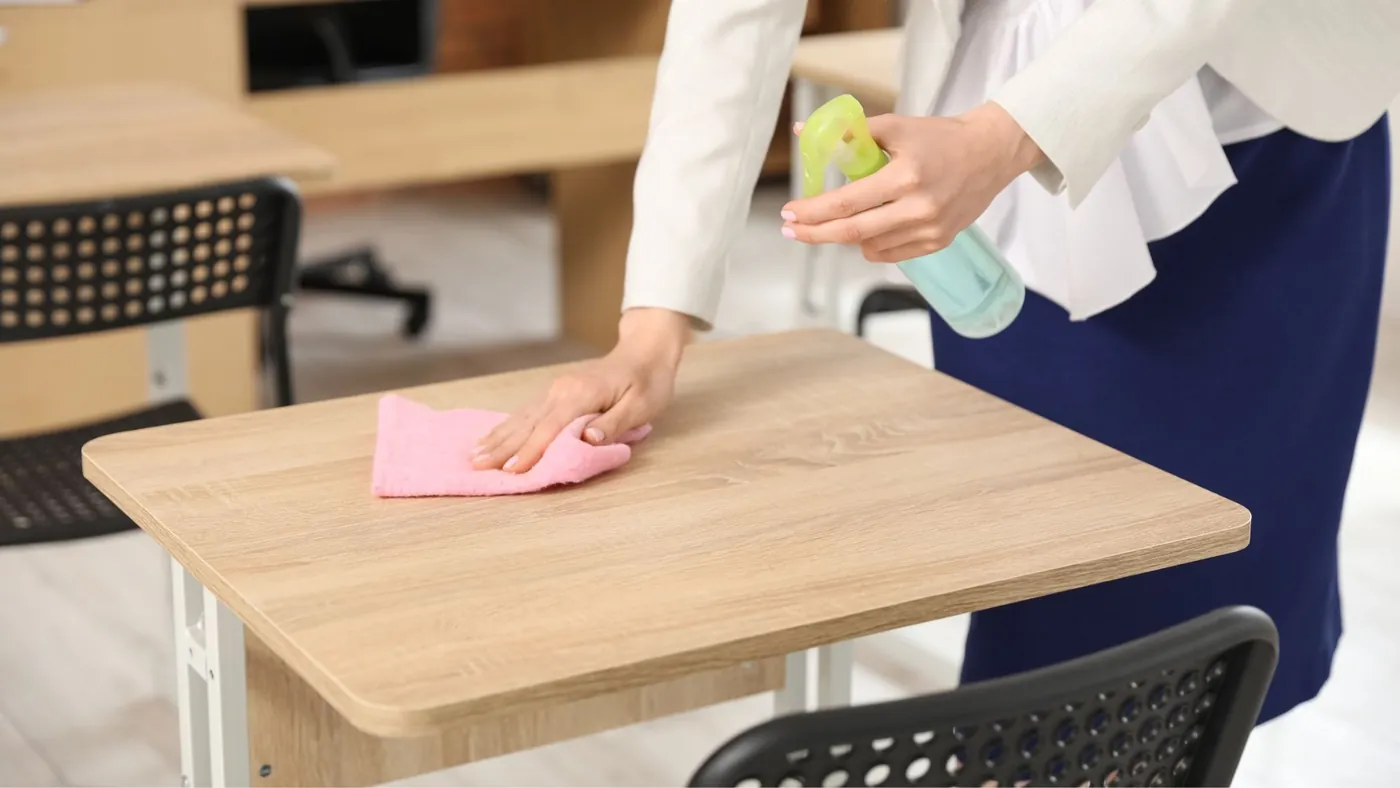
- Desk and table surfaces — Shared between pupils across multiple lessons and year groups.
- Toilet facilities — High-frequency use by multiple age groups, with variable handwashing compliance.
- Light switches and bannisters — High-touch but often overlooked in basic cleaning schedules.
- Canteen surfaces and serving equipment — Areas where food handling and shared contact combine to create elevated risk.
- ICT equipment — Keyboards, mice, and tablets shared between pupils with no self-cleaning mechanism.
Virucidal Products and Correct Dwell Times
Not all cleaning products are equal when it comes to infection control. In a school environment, disinfectants must be virucidal, meaning they are proven effective against viruses as well as bacteria. Products should meet relevant EN standards, which confirm efficacy under laboratory conditions against specific pathogens. Dwell time is equally critical. A disinfectant only works if it remains on a surface for the time specified by the manufacturer before being wiped away. In practice, this step is frequently skipped, particularly in busy school environments where speed is prioritised over process. Professional infection control school cleaning teams are trained to observe dwell times as a non-negotiable part of the protocol. The Health and Safety Executive's guidance on COSHH applies to all cleaning products used in schools. Any contractor providing infection control school cleaning must assess the products they use, ensure staff are trained in safe handling, and maintain appropriate documentation.Frequency of Disinfection During Term Time
One of the most common gaps in school cleaning provision is frequency. A once-daily clean, however thorough, is not sufficient to manage infection risk in a high-footfall environment. Effective infection control school cleaning typically involves:- Before school — Full clean and disinfection of all classrooms, toilets, and communal areas before pupils arrive.
- Midday — Targeted disinfection of canteen surfaces, toilet facilities, and high-touch points in communal areas.
- After school — Full clean of all teaching spaces, including desks, chairs, ICT equipment, and floors.